HR Films In Good Hands: Five Days at the 100% Manusia Film Festival
How does Human Rights Cinema look in Southeast Asia and who keeps it alive? Cinema without Borders is an initiative of Movies that Matter that has been supporting film festivals across continents, including the Indonesian 100% Manusia Festival. Read the insight of King Catoy on what it was like to be a part of the 100% Manusia Film Festival 2026 in Jakarta as an "odd one out". 17 September, 2026
King Catoy, an employee at Cinemata.org , a video platform for social issues about the Asia-Pacific, has shared their meaningful experiences at the 100% Manusia Film Festival 2026 with Movies that Matter. Take a look at just how alive Human Rights Cinema is in Southeast Asia.
“I went to Jakarta as an odd one out.
Everyone else at Cinema without Borders came representing a film festival. I came from Cinemata.org, a platform. Lately my work at Cinemata has leaned technical, closer to the platform than to the programming, even though the two have never really been separate for me. So I arrived quietly, as someone who wanted to understand what human rights film festivals in this region actually need, and who they are run by.
What I found was that human rights filmmaking, in that room, was not on the margins at all. That surprised me more than it should have. At Cinemata.org we spend a lot of energy just explaining what a social issue film is. We work in an ecosystem where short films outside the big platforms are scattered, and where much of the serious work sits inside an art-house logic that keeps it at a distance from the people it is about. For five days in Jakarta, none of that needed explaining. Everyone already knew. I felt, for once, like I was standing in the middle of something rather than at its edge.
Who is 100% Manusia?
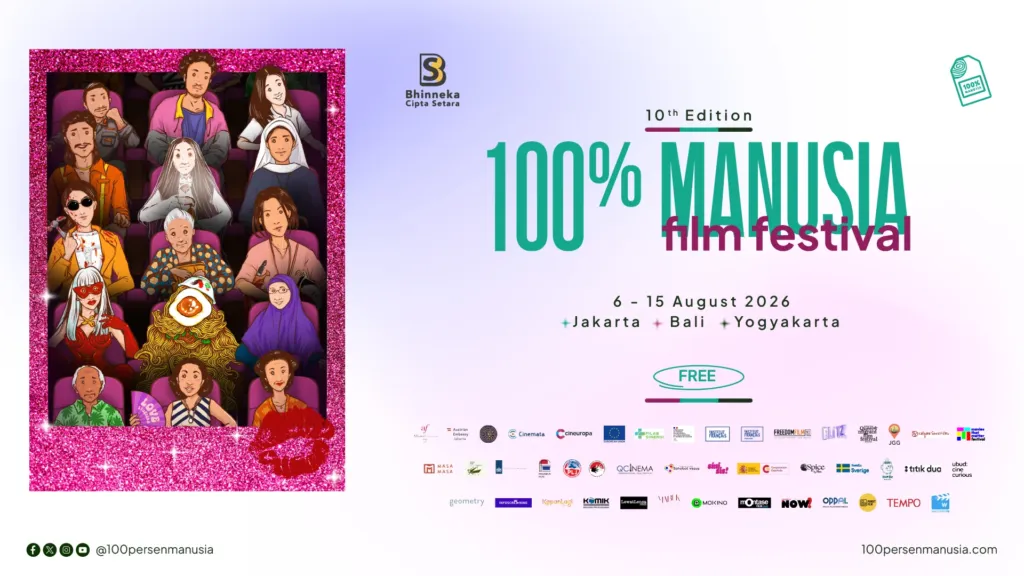
A lot of that feeling came from the organisers, who are the elders of this field whether they would use that word or not. 100% Manusia hosted us in the middle of its tenth edition, A Decade of Love Language. Manusia means human, and the festival lives up to it, screening queer films and other stories that a growing conservative current in Indonesia would rather keep off the screen. Menina Putri and their team of directors do it anyway, and they do it free, and they do it as a safe place to watch and to talk.
Freedom Film Festival from Malaysia felt like the auntie of the whole group. Steady, a little fierce, still going after two decades when many would have stopped. I sat with people who have paid a real price for this work. Years ago, one of their organisers, Lena Hendry, was arrested and later fined simply for screening a documentary about the Sri Lankan civil war that the censors had not approved. She was the first person in Malaysia charged for showing a human rights film. More recently the festival’s own director, Anna Har, was called in by police and had her office raided over a four-minute animated short about a death in custody. Anna was in the room with us. You listen differently when the person telling the story is the person it happened to. They also spoke about standing by the filmmakers behind Mentega Terbang, who were attacked online and had their properties damaged. These are not cautionary tales to them. They are Tuesdays.
And there was Movies That Matter behind all of it, quietly. Cinema without Borders is their initiative, running since 2006, this time the 22nd edition, co-organised with 100% Manusia. Through their grants they have backed more than 375 human rights film events in over 85 countries since 2007, and they hold together the Human Rights Film Network that many of these festivals belong to. Long before impact became a word everyone had to say in a funding report, they treated films and festivals as things you learn from. Education is not a bolt-on for them. It is built into the structure. Much of what the rest of us do, they helped make possible.
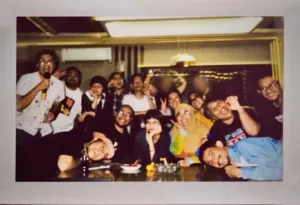
The cohort itself was the other half of the gift. Programmers and filmmakers from Indonesia, Malaysia, the Philippines, Thailand, Vietnam, Cambodia and Myanmar. Akbar from Aceh runs a village cinema, carrying films to rural places that have no theatre at all. Claudette, from Kupang, wants to build community screenings that can actually last, the kind that outlive a single event. Friends from Hanoi hold their community together through small cine-hubs. A few of the younger initiatives stayed with me. Penang Shorts is a new venture built around short film, taking its cue from Freedom Film Festival. Festival Film Jelek, out of Central Java, translates as the Ugly Film Festival, a name that makes you laugh and then makes you think. Why call your films ugly when they are the ones the bigger Indonesian festivals turned away? Because the joke is the point. It is a safe place for emerging filmmakers to experiment and to learn, rejects welcome. And in Bangkok, CCCL, Changing Climate, Changing Lives Film Festival, is a growing home for environmental and climate films, not only from Thailand but from across the region. We were very different, and yet the conversations never needed a running start.
From community screening to a festival
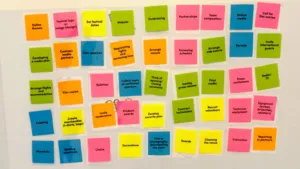
One exercise has stayed with me. Anna Har and Julie Nederkoorn gave us cards, each one an activity in organising a festival, and asked to put them in order. There is no single order. There cannot be. It depends on the scale of the festival, its character, and what it is for. The learning was not in getting it right. It was in discussing, in listening to how another group had reasoned, in having to explain why we placed a card where we did.
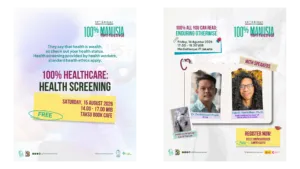
One session changed how I think, and it was about fringe events, the things that happen around the screenings. I came away convinced these are often what turns a community screening into a festival. A poetry reading, a small art exhibit, a workshop, even a karaoke night, each one opens a different door and brings in an audience that might not have come for the film alone. For a human rights festival, where the whole point is advocacy, this is a natural extension rather than a decoration. I started to see fringe events as a creative act in themselves, a way of shaping what the festival is and who it is for.
Two sessions sharpened things for me. One was on impact, led by Suryani Liauw. Her point was simple and hard. Your big idea has to be sayable in a few words, plain enough for an outsider to grasp. If you cannot say it, a partner cannot support it, a funder cannot fund it, and maybe you have not understood it yourself. The other was on funding, led by Julie Nederkoorn and Felencia Hutarabat, which was the topic the whole room leaned toward, because it is what all of us want and lack. We mapped funders, traded names, argued gently about the ethics of who you take money from. The conclusion I carried out was this. We all dream of the one big funder. But the real strength is the network. The allies in advocacy who rarely have money, and who will give you their expertise, their knowledge, their room, their trust.
The thing I will not forget is the people who came from Myanmar. I will not name them here. But watching them keep this work alive against odds most of us cannot imagine reset my sense of what is possible. If the future of human rights cinema in Southeast Asia looks anything like the people I spent these five days with, then it is in good hands.
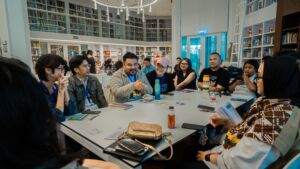
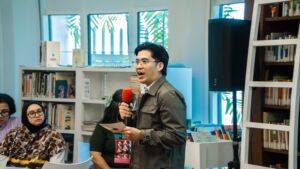
I have to be honest about the pitch. I am not fully sold on the form. I worry it rewards the confident talker over the good idea, the extrovert over the careful one. But I learned it anyway, through Chris Belloni’s session and the honest feedback of the mentors and my fellow participants. And I came around, partly. Being a smooth speaker helps, yes. But knowing your idea, and knowing why someone should care, matters more. It comes down to knowing yourself and the thing you are trying to make. The pitch was the natural peak of the week. More than fifty people came, including representatives from cultural embassies and other film initiatives. Everyone took it seriously.
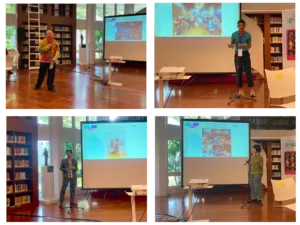
I took my own pitch to heart, because it was the best way to understand what these festivals face. I pitched 480 Lines, a small hybrid festival to preserve and upscale the political video work made in the Philippines during the digital video decade, and to bring it back to the community spaces where it first belonged. Standing up to defend it taught me more about festival organising than any slide could.
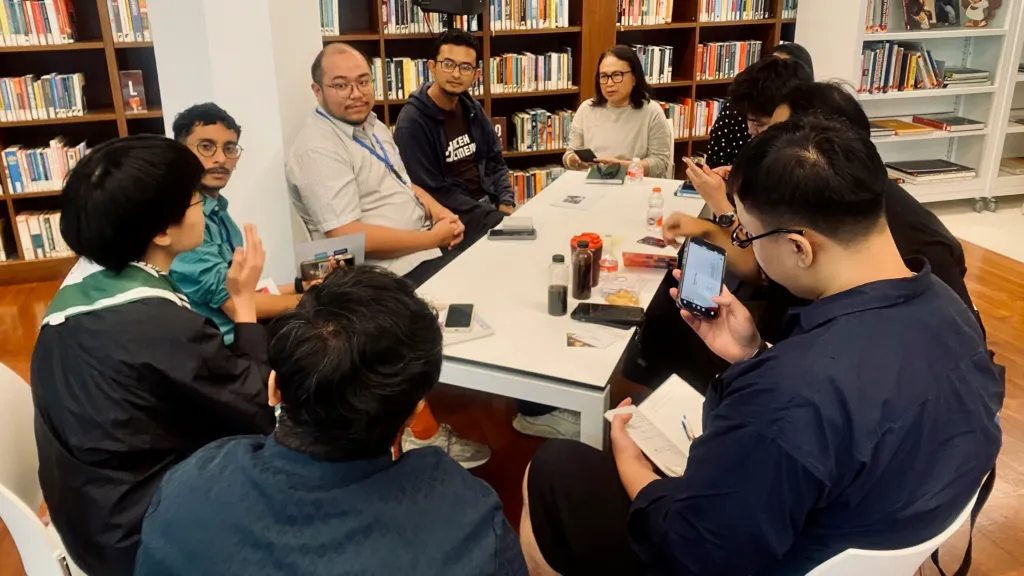
The heart of the matter
It also led me somewhere Cinemata-shaped. So much of this work now sits behind heavy locks. Films made almost inaccessible by their own distributors and makers, often for good reason, since many carry screening fees and many more carry real risk to the people inside the frame. There is a quieter thing I want to press on with too. It is easy to see Cinemata as a fully public shopfront, every film out in the open. Most are, but not all. A small share of what we host is private and password-protected. Some of those filmmakers cannot afford a paid Vimeo account. Others simply would rather not push their work to festivals and selection committees through Google Drive, or hand it to another Big Tech platform. I want to gently encourage the people I met to make more use of this. Not as a pitch, but because it is exactly the kind of need Cinemata was built to meet.
This whole knot, access and security and who gets to see what, is one the Cinemata community should keep pulling at, in writing and in gatherings. My hope is modest and stubborn. That one day more filmmakers, especially human rights filmmakers, will choose to keep their work on a platform like Cinemata after its festival run, rather than let it vanish into deep wells of Big Tech or into a drawer. Protecting a film from illegal access is a cat-and-mouse game, and it always will be. But our starting point is the safety of the people on screen and the people who filmed them, not a paywall. If we get that right, the rest can follow.
The thing I will not forget is the people who came from Myanmar. I will not name them here. But watching them keep this work alive against odds most of us cannot imagine reset my sense of what is possible. If the future of human rights cinema in Southeast Asia looks anything like the people I spent these five days with, then it is in good hands. I came to Jakarta to understand what Southeast Asia’s human rights festivals need. I left knowing more, part of something, and a little braver.”
The most recent 100% Manusia Film Festival took place from 6th until 15th of August. Stay up to date on their next editions through Instagram .
Read more
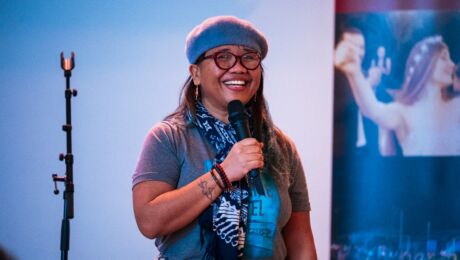
Ripples of Change: Meninaputri Wismurti and the 100% Manusia Festival
At our festival this March we met up with Meninaputri Wismurti, who gave several workshops for international festival organizers during the Cinema without Borders programme. A veteran of the film industry, she is the co-founder and programme director of the yearly international 100% Manusia festival in Jakarta, Indonesia. She discusses some of her greatest challenges and victories in organizing her human rights festival with us.
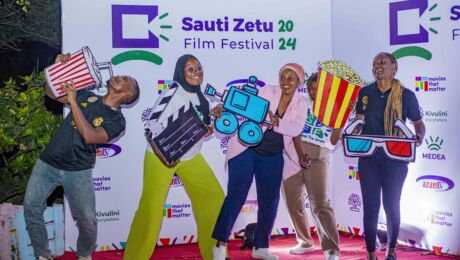
Beyond the Screen: How We’re Carving Out Space for Human Rights in Tanzania
Movies that Matter has been supporting film festivals all over the world with our Grant Programme. Every now and then we invite grantees to share their insights. For this edition Elias Maeda, Founding Director of the Sauti Zetu Film Festival in Tanzania, elaborates on the effects on his community he experienced after the festival and gives a little sneak peek into new plans.
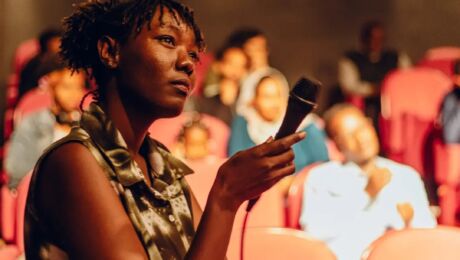
Sarah Mpapuluu on Building a Human Rights Film Festival in Kenya from the Ground Up
Sarah Mpapuluu is the Festival Coordinator and Co-Founder behind the Under Our Skin International Film Festival on Human Rights in Kenya, which has been spotlighting powerful stories since receiving its first start-up grant from Movies that Matter in 2020. Now four editions in, the festival continues to grow as a platform for dialogue and change.
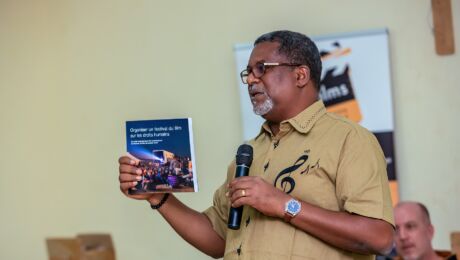
Abdoulaye Diallo on Using Film to Challenge Injustice and Amplify African Voices
In Burkina Faso, a country grappling with conflict, displacement, and deep uncertainty, filmmaker and film festival organiser Abdoulaye Diallo has chosen the camera as his tool of resistance - and the film festival as a stage for hope. We spoke with him about his view on films in relation to human rights and how the Human Rights Film Network offers a sense of solidarity to other human rights film festival organizers.