Witnesses to genocide – a call to action
At the festival we screened the film Inside Gaza (2025) by Hélène Lam Trong. On March 22 the screening was introduced by Jan Pronk, former Dutch Minister for Development Cooperation. He shared his observations with us, so we can share it with you. 20 April, 2026
Images can tell us more than words. I have been asked to introduce the film which we are going to watch – Inside Gaza – with a speech. I will not do so. This impressive documentary speaks for itself. I will limit myself to three observations.
First. In 1980 UNESCO published a report on the concept of the New International Information Order. (1) It was written by a commission chaired by a former Chief of Staff of the Irish Liberation movement IRA who later became Minister of Foreign Affairs of the Republic of Ireland, Sean MacBride. He was founder of Amnesty International and in 1954 received the Nobel Peace Prize.
The concept of a New International Information Order was controversial. The idea was that in the future information about developments and conflicts in the South – such as presently in Gaza and the West Bank – should primarily be given by Southerners themselves, rather than by Western press agencies and other media. That idea was contested by Western politicians and journalists who still felt superior, knowing better than the people who were subjected to abuse and violence and suffered from the pain of wars in the South. However, Sean MacBride was a statesman who carried weight and his commission included well known journalist and authors, amongst them Gabriel Garcia Marquez. So, the report could not easily be dismissed.
I was member of that commission. I remember that one of our difficult points of discission was the question whether we should recommend governments to establish international legal protection of journalists. There were important reasons in favor of such official protection. Just like today journalists were persecuted. They were threatened, taken hostage, and killed by warring parties and governments themselves.
When journalists can no longer report about the killing of women and children, the occupying power is free to continue injustices.
However, there were important hesitations. Who defines who is or is not a journalist? Governments, who are parties in control? Moreover, what about civilians who do not have been registered as journalists, but give accounts of what is happening, write blogs, make pictures, and send them around? Should these people not be protected as well? If not, they run the risk of being outlawed.
After lengthy discussions, weighing all the arguments, we decided to give up the idea of official legal protection. However, in hindsight, we drew the wrong conclusion. There is no contradiction between protection of journalists and other people. On the contrary, protection of journalists serves protecting civilians. That is why, as we see in Gaza, the Israeli’s kill journalists. When journalists can no longer report about the killing of women and children and not send abroad pictures of demolitions and expulsions, the occupying power is free to continue injustices.
Second. Twenty years ago, I was leading the United Nations Peace Operation in Sudan. For more than seventy years a liberation war had been fought by the South against the North. We were successful in helping the warring parties to make peace. However, in the meantime in Darfur, in North Sudan, a civil war had broken out, leading to genocide conducted by Arab militia, the Janjaweed, against people with other ethnicities. Hundreds of thousands were killed. Millions were displaced, living as refugees in camps without adequate protection and means of survival. Governments refused to provide our Peacekeeping Mision with sufficient means to do what we had to do.
In 2005 I was invited to speak at a festival of World Press Photo in Amsterdam. I told the audience about the horror in Darfur and asked journalists and photographers to visit Darfur and to report. ‘Please come. We need more stories and more pictures.’
That year only one photographer came: Kadir van Lohuysen. The killing continued. We desperately drafted reports to UN Headquarters and to the Security Council but could not mobilize public opinion to press their governments for action. On the contrary, governments, despite deciding that same year that the international community had a Responsibility to Protect (R2P) ‘populations from genocide, war crimes, ethnic cleansing and crimes against humanity’ continued looking aside. The genocide never stopped. It goes on until today. There are no witnesses. Stories are not being told, pictures are not being shown.
Genocide conducting does not tolerate witnesses.
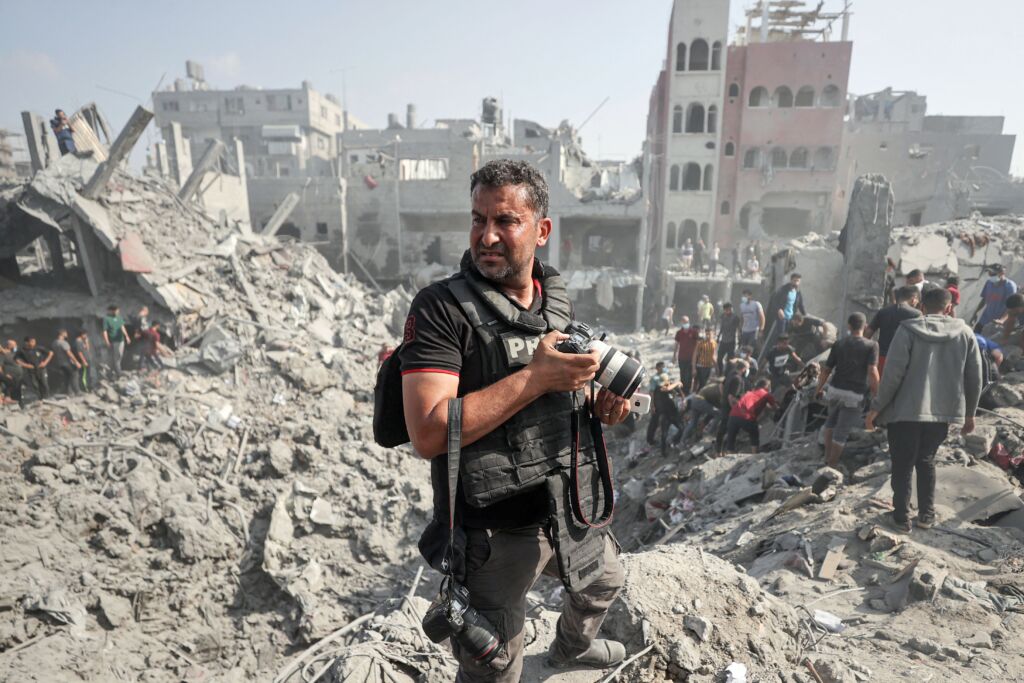
Third. In today’s documentary we see a group of Palestinian journalists and photographers working for Agence France-Press. They live and work in Gaza, in the heart of the Palestinian agonies. They report about the torments suffered by the people and by doing so they themselves become the target by Israeli drones and bombs. The Israeli do not only kill women and children, but also relief workers and journalists, knowingly and willingly. Conducting genocide does not tolerate witnesses. However, doctors and reporters continue what they must do and we admire their courage.
Despite Israeli action to suppress all information about their crimes we know what is happening. We see the pictures and listen to the war reports presented to us by AFP, Al-Jazeera and by the people of Ghana, using their smartphones. Outside Gaza we are flooded with stories and pictures. If you want to know, you can, day by day. In that respect, Gaza is different from Darfur.
However, despite all this, there is no action. The world looks away. Political leaders, in particular Western leaders, including the Dutch, are complicit by their silence. Will they say, later, ‘Wir haben es nicht gewusst? Impossible, the world is watching.’ We have all the information: it is a systematic erasion of Gaza, deliberate genocide.
Listen to Itamar Bven Gvir, Israeli minister of National Security: ‘They should be crushed to pieces, starved to death and not resuscitated with humanitarian aid that gives them oxygen.’
Listen to Belazel Smotrich, minister of Finance: ‘It might be justified to let 2 million Palestinians die of hunger’.
Listen to Amihai Ben Eliyahu, minister of Heritage: ‘The army must find ways more painful than death for the civilians in Gaza. Killing them is not enough.’ Minister of Heritage: what is in a name?
Indeed, that is what is going on: bomb to kill, crush to pieces, using ways more painful than death. Gaza is a modern killing field. The people flee from North to South, and back. From one city to another, and back. From the cities to the beach, and back. Time and again. There is no safe place. And while sleeping in the ruins of their houses, living in leaking tents or walking along the wreckages of their homes and hospitals, they are the target of modern experimental high-tech warfare.
Listen to their voices as recorded: ‘It is an Apocalypse.’ ‘We flee from death to death.’ ‘The world has lost its moral compass.’ Listen, watch, and speak out. This is not only a film. It is a call for action.
This introduction was organised in collaboration with literature festival Read My World.
Notes
- Many Voices, One world. Toward a new, more just and more efficient world information and communication order. Report by the International Commission for the Study of Communication Problems, president: Sean Mac Brde. Unesco, Paris, 1980.
- Jan Pronk, We Need More Stories and More Pictures. Address 50 Years World Press Photo, Amsterdam. October 8, 2005
- UN resolution A/RES/60/1. par 138-140.
Read more
Festival Films 2026: In Theaters and Streaming
Did you miss a film during the festival? No worries! We have listed for you which festival films will be released in cinemas or are available to stream soon.

9 film tips to better understand the situation in Israel and Palestine
As long as our festival exists, we have been seeing and showing films about Israel and Palestine. To better understand the events of the past few weeks, it is important to know the context and history. To provide some insight into this, we have made a selection of films that were previously shown at our festival and that can still be viewed online.
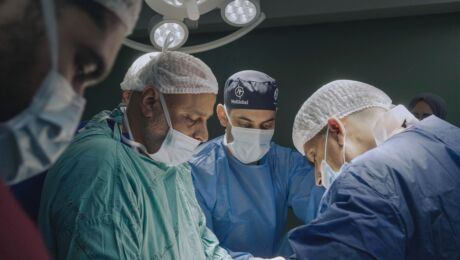
American Doctor opens the Movies that Matter Festival 2026
The first titles of the Movies that Matter Festival 2026 have been announced! American Doctor by Poh Si Teng opens the festival on Friday 20 March. In addition, we highlight the eight nominees for the Grand Jury Documentary competition.